
Stablecoin transaction volumes hit $33T in 2025. Stripe acquired Bridge. PayPal launched PYUSD. The conversation is no longer whether stablecoins matter. It's who builds the commerce layer that makes them usable for real businesses.
We've always been fascinated by things that just work. Invisible, yet so woven into daily life you can't imagine going without them.
Breathing. You don't think about it. You just do it.
Google. You don't need to be a tech expert. You just type, and it works.
In 2017, we were sitting at a cafe watching people scan a QR code taped to the counter and pay from their phones.
That's it.
Then slowly, we saw college kids, rickshaw drivers, and small shop owners start using UPI. Gradually, all of India adopted a payment system that worked from existing phones and a 10-cent QR code.
Later, the same system got integrated into POS machines, online checkouts, apps, and businesses.
That's how every successful technology shift has worked. It slips into the life people are already living and quietly makes it better.
But when we talk about crypto payments today, it still feels like you need to become an expert just to use them.
Learn a wallet. Learn a chain. Learn gas. Migrate your checkout. Buy new hardware. Train your staff. Hire a developer. Then maybe you can accept payments.
It almost feels like a payment revolution that still requires people to completely change how they already operate.
So while everyone else is busy building new wallets, new chains, new neobanks, asking merchants to throw out what works and start over, we're building something else.
We're building a commerce layer that plugs stablecoins into the payment systems businesses already use. One integration, and you start accepting stablecoins everywhere your customers already pay you: online checkout, in-store POS, in-app, by QR.
Same dashboard. Same business. Same staff.
Why now
Because we're at a unique moment in commerce.
Stablecoins are no longer just a crypto-native tool. They're becoming a real payment rail.
Stablecoin transaction volumes have surpassed major traditional payment processors, totaling over $33 trillion in 2025.
Stablecoin payment volume is up roughly thirty times in five years. Regulation cleared in every major market: Japan and Singapore in 2023, MiCA and the UAE in 2024, the GENIUS Act in the US in 2025. And the largest financial companies in the world moved in.
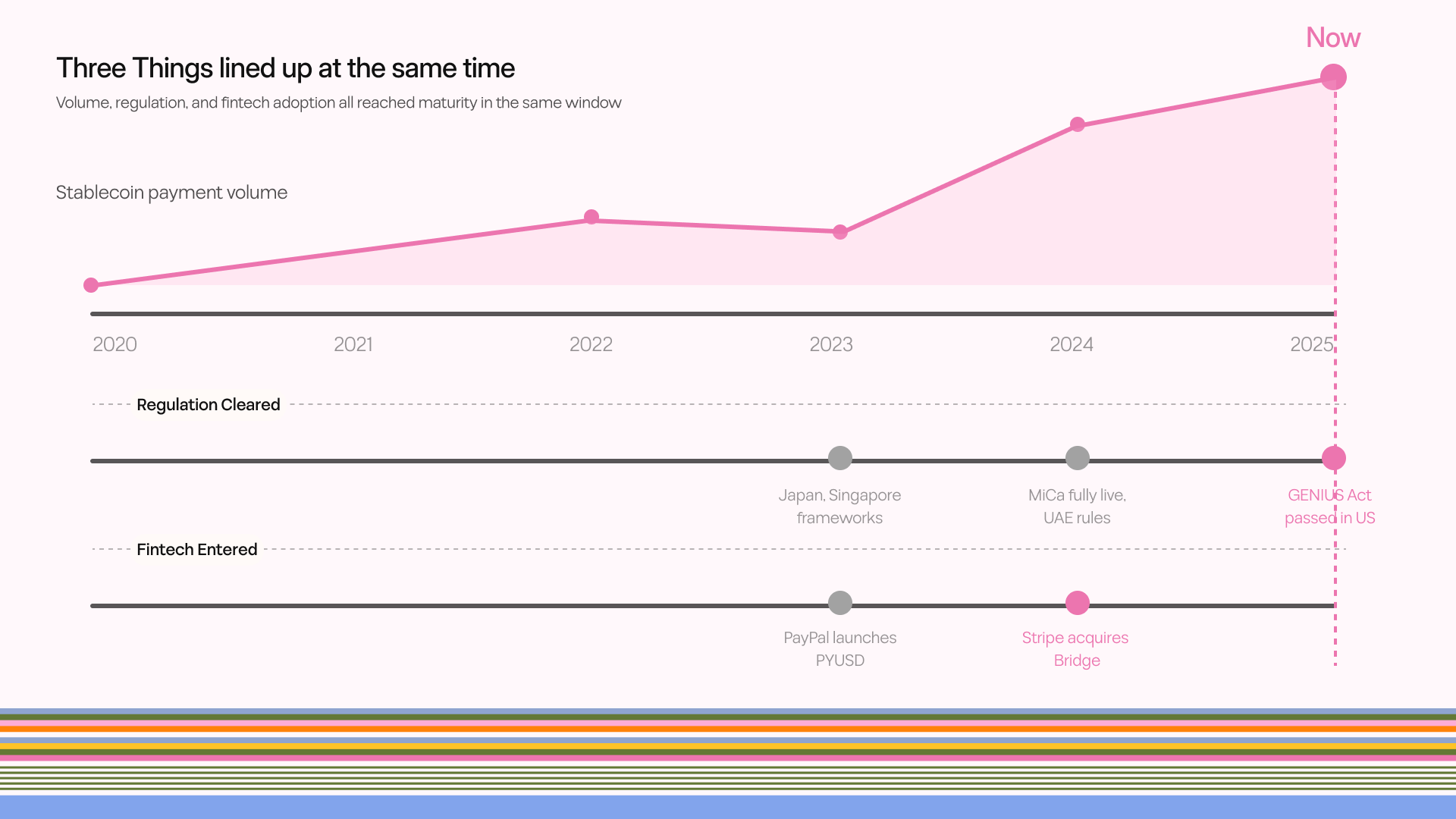
Stripe acquired Bridge. PayPal launched PYUSD. Visa is expanding stablecoin-linked card programs. Mastercard is moving deeper into stablecoin settlement infrastructure.
The conversation is no longer whether stablecoins matter. It's who builds the commerce layer that makes them usable for real businesses.
That is where Stableyard sits.
And that is why we are excited to announce a strategic investment from Movement.
Movement gives us a settlement environment optimized for fast, programmable, stablecoin-native payment flows. Stableyard turns those rails into usable commerce products. DopePay puts those experiences directly into the hands of users and merchants.
The missing piece
Today, most crypto payment products stop at:
“Wallet sends money → another wallet receives money.”
That's not a payment system. That's a transfer.
A payment is what happens around the transfer. Settlement, payouts, reconciliation, refunds, permissions, recurring billing, QR / POS integrations, reporting.
Until those exist, no real business can run on stablecoins. A creator can't run a subscription. A hotel can't issue a refund. A SaaS company can't bill 10,000 customers a month. The chaiwala can't take a stablecoin payment without becoming a developer first.
That's the gap Stableyard exists to close.
What we're really building
The end goal isn't a stablecoin processor.
The end goal is a unified commerce layer for stablecoin payments. The layer that lets any business, anywhere, accept money from anyone, settle in any currency, pay anyone, and run their full financial operations from one system with instant settlement, lower fees, and built-in payouts.
We manage the full payment lifecycle from checkout to settlement so teams can earn more, think less, and run payments globally without changing how they operate today.
That includes:
- Stablecoin checkout for websites and apps
- QR and POS payments for physical merchants
- Embeddable widgets and payment SDKs
- Deposit addresses for businesses and platforms
- Payouts, refunds, and reconciliation
- Embedded payment experiences inside products
- Dope Pay as the consumer-facing payment layer
Stablecoins are the rail underneath that makes this possible. They don't care about borders, banks, or business hours. The work we're doing is building the application layer that turns the rail into a usable product.
The year is 2025: Pick your poison
We talk to ten merchants a week. Nine out of ten conversations fall into one of two buckets.
First, the "3% is just the cost of doing business" crowd. Heads down. Eating the fee. Eating the FX markup. Eating the chargeback. They've been told for fifteen years this is how it works.
Then the "there has to be a better way" crowd. The CFO has run the numbers. International cards: 3.5%. FX: another 1.5%. Chargebacks: another 1%. On $500K in monthly orders, they're losing $30K a month to a system that wasn't built for them.
More merchants are jumping from the first bucket to the second every month.
By 2026: Stablecoin acceptance feels like a card
By 2026, we want stablecoin acceptance to feel as normal as card acceptance or QR payments.
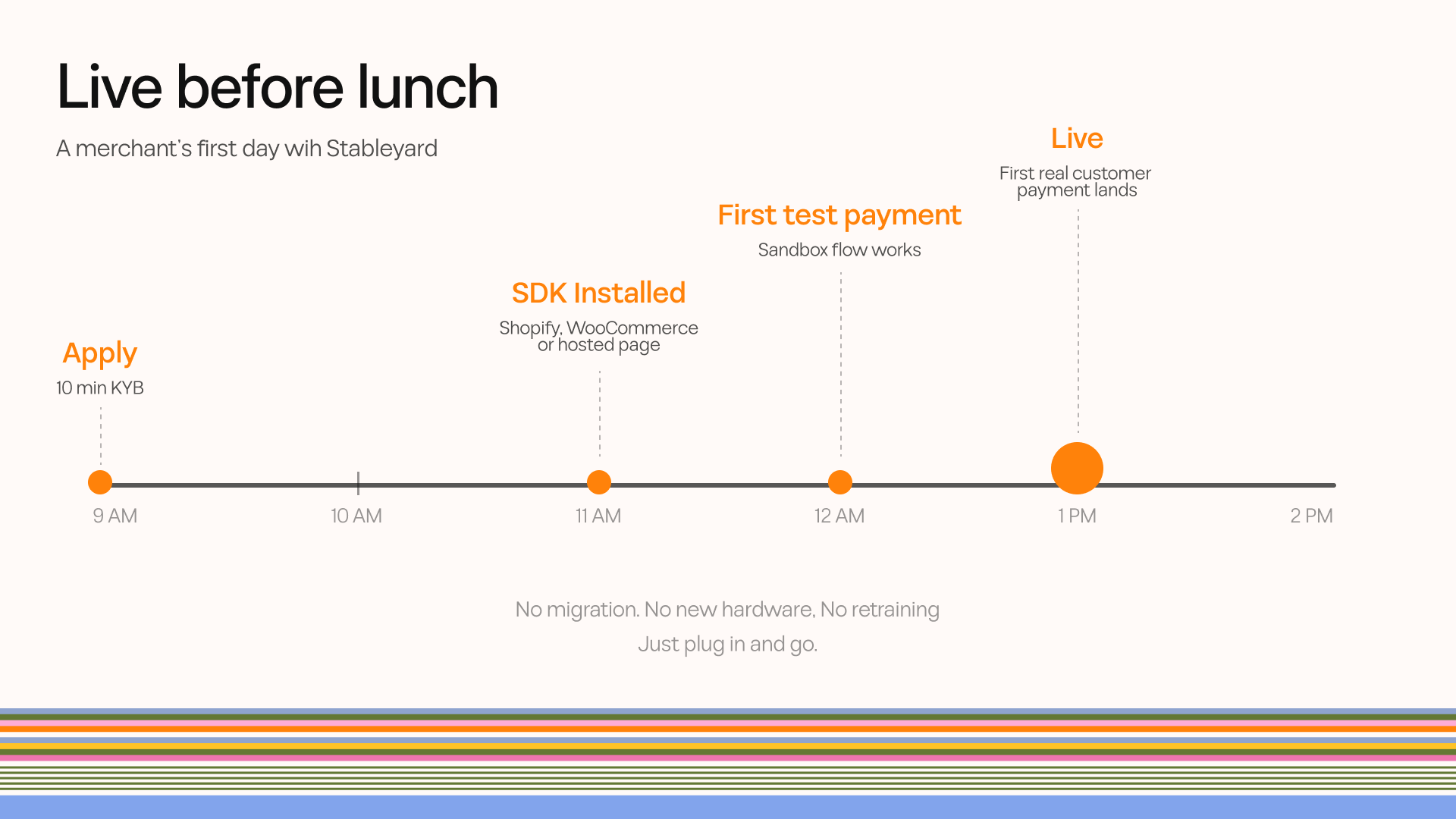
A merchant should be able to go live in hours, not months.
They should be able to:
- Add stablecoin checkout to a website
- Accept QR payments in-store
- Use existing POS systems
- Issue refunds and partial captures
- Reconcile transactions automatically
- Manage payouts from one dashboard
The customer should not need to understand what happens underneath.
They pay.
The merchant gets paid.
Stableyard handles everything after that.
By 2027: Commerce runs in parallel
Picture a restaurant chain operating across three cities.
Today, they use separate vendors for QR payments, card processing, subscriptions, payouts, refunds, and bookkeeping.
By 2027, that will become one system.
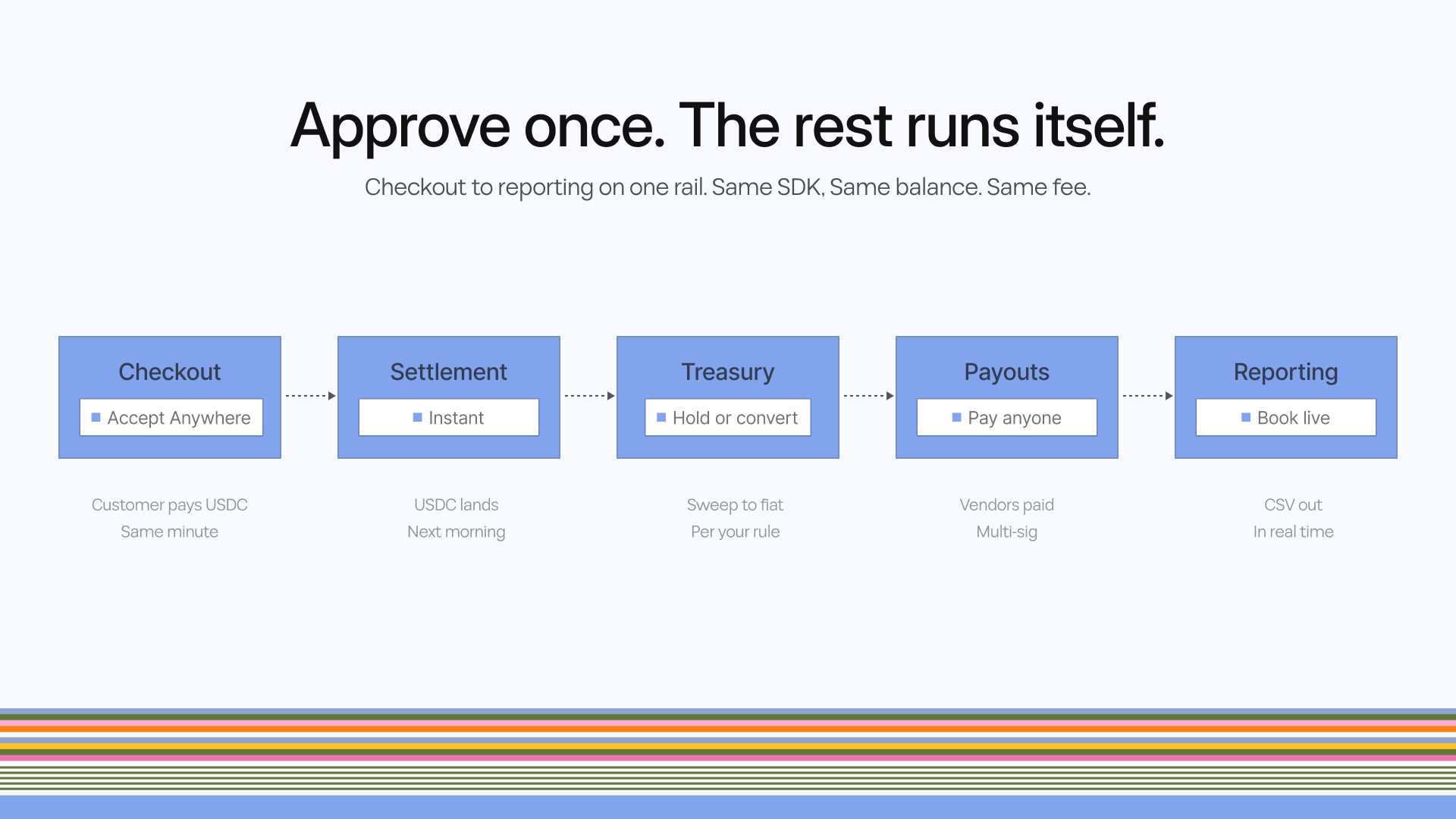
Stableyard handles payment acceptance, merchant settlement, vendor payouts, reconciliation, and recurring billing from a single dashboard.
Long term: Invisible commerce, everywhere
Paying with stablecoins should feel no different from scanning a QR code or tapping a card. The merchant shouldn't have to think about chains. The customer shouldn't have to think about wallets. The payment should just work.
That's how every payment shift becomes mainstream. It stops feeling like technology.
Stripe didn't win because TCP/IP got better. Stripe won because it built the layer on top that businesses could actually use.
“Stablecoins are the rail. Stableyard is the layer that makes them usable.”
What this investment helps us do
Movement's strategic investment helps us accelerate that vision.
We are using it to deepen our work across:
- Stablecoin checkout
- QR and POS payments
- DopePay merchant experiences
- Settlement infrastructure
- Reconciliation and payout tooling
- Movement-native payment flows
The next phase is simple.
Get merchants to live.
Get users paying.
Make stablecoins feel like payments, not crypto.
Stablecoins are becoming the new payment rail.
The future of payments will not look like crypto.
It will just feel like better commerce.
Build the commerce layer with us.
Stableyard is invite-only while we onboard merchants. Apply for access and we'll come back within one business day.