

Stablecoins move everywhere. They spend nowhere. A Bank of Italy study priced the whole journey and found the on-chain hop costs about 0.4% while the full trip runs to almost 9%. The expensive part is getting money in and out. And even if that were free, the money still arrives outside every till, QR code and payroll run.
Stablecoins move everywhere. They spend nowhere.
Every company in stablecoins is selling the same big volume number: $3 billion, $5 billion, $10 billion moved. Then comes the same pitch: fast, cheap, borderless.
But when you look a little deeper, the story starts to change.
A lot of that volume is simply money moving from one border to another. And the “cheap” part is often measured against banks, because the moment you measure it against Wise or Remitly, it stops looking cheap, and moving money is not the same as spending money.
A merchant who accepts USDT still can’t necessarily pay their suppliers or payroll with it. A customer holding digital dollars still can’t walk into most local shops and spend them directly.
“So the world has local rails that spend everywhere but move nowhere, and global money that moves everywhere but spends nowhere.”
That’s the gap nobody wants to talk about.
It’s not cheaper than the thing you actually use
Stablecoins are sold as a cheap way to move money across borders. But when you look at the full transaction, it gets less exciting.
A recent Bank of Italy study sent 200 USDC across 10 routes and counted every fee, funding, conversion, transfer and cash-out. Total costs ranged from 0.3% to almost 9%. The actual blockchain transfer was only 0.4% of the total cost. The expensive part was getting money into and out of the stablecoin system.
The filling is free. Dollar to dollar, wallet to wallet, the on-chain hop averaged 0.4% of the amount sent, and in one case 0.01%. That part of the pitch is completely true.
But nobody gets paid in the filling. You put local money in one side and you pull local money out the other, and the bread is where the money goes. The deposit fee. The exchange spread. The withdrawal charge. The bank sitting at the far end. On the UAE route, the only funding method available was a credit card, and the card surcharge alone was 3.8%, the total came to 8.95%.
So yes, moving stablecoins is cheap. Turning them back into money is where the cost comes back. And nobody cares that $200 of USDC moved for a fraction of a cent if they still have to pay 2%, 3%, or 5% to get it into their bank account.
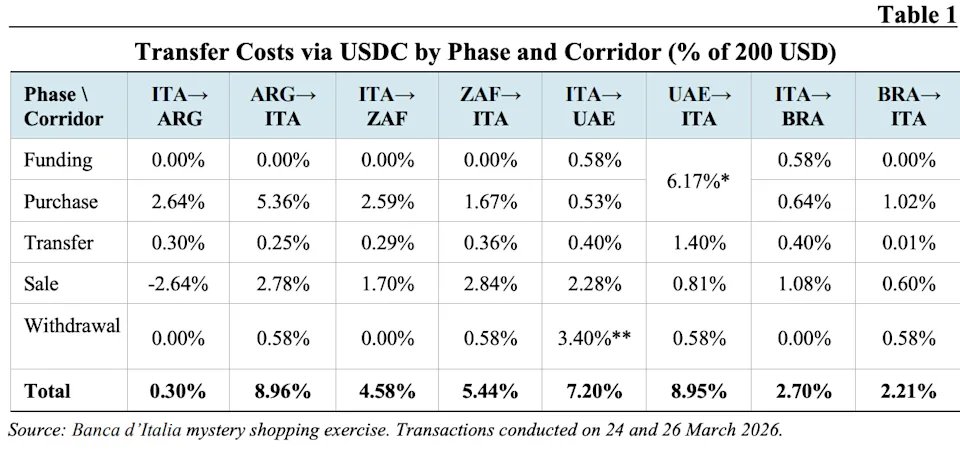
That’s the real problem stablecoin payments still have to solve.
The last mile.
The bigger problem isn’t cost. It’s connection.
Say the cost problem gets solved tomorrow. Stablecoins become almost free to move. You still have the bigger problem: the money arrives, and then what?
It sits in a wallet, outside every till, QR code, payroll run, or local payment rail. To actually use it, you have to convert it, and that conversion is somebody’s margin.
The industry’s workaround is to put a card on top: connect your USDT or USDC to Visa or Mastercard and spend anywhere. It works, but the shop is still processing an international card payment and can pay 2–4% for it. For a retailer running on 5% margins, that isn’t a small fee. That’s the business.
And this is where the local payment problem comes in. India has UPI, Brazil has Pix, Southeast Asia has QR networks and wallets, and Africa has mobile money. These systems are great at moving money locally, but they aren’t built for global movement. Stablecoins have the opposite problem: they move globally, but don’t automatically work at the shop next door.
So the real problem isn’t making stablecoins cheaper.
It’s connecting global money to the local rails people already use.
The real problem is the last mile
So it all comes down to the thing that the world has local rails that spend everywhere but move nowhere. And global money that moves everywhere but spends nowhere. Both work. They just don’t talk to each other. That’s where most of the problem with stablecoin payments comes from.
That connection is our product.
Money enters from any chain, any wallet. Inside the network it moves for close to nothing. A customer pays a merchant. A merchant pays a supplier. A company runs payroll. And when someone on the network has to pay someone who isn’t, a vendor overseas, a supplier who has never heard of a stablecoin, the network off-ramps it at the edge. The sender pays in stablecoins. The recipient gets their own currency in their own bank. Neither of them has to know what happened in between.
Merchants reach all of it without changing anything. Stableyard integrates once with PSPs and POS providers, and every merchant underneath accepts stablecoin payments through the same system that already takes cards, QR and Apple Pay. They settle in stablecoins or fiat, instantly, at about 1%. We’ve also built our own card and POS, where the payment never touches a card network at all.
Then the part that compounds. Today money converts at nearly every hop, and every conversion is somebody’s margin. On this network there is one conversion, at the edge, at a price everyone can see. Wallets and exchanges plug into the spending side. Every new wallet makes the merchants more valuable, every new merchant makes the wallets more valuable, and each one that joins takes another conversion out of the chain.
“The network gets cheaper the bigger it gets. No card network has ever done that.”
Payments were never won by whoever moves money fastest. They’re won by whoever becomes the place two systems meet.
Build the commerce layer with us.
Stableyard is invite-only while we onboard merchants. Apply for access and we'll come back within one business day.